
Apple AI Strategy Traded The Frontier For Distribution
July 28, 2026
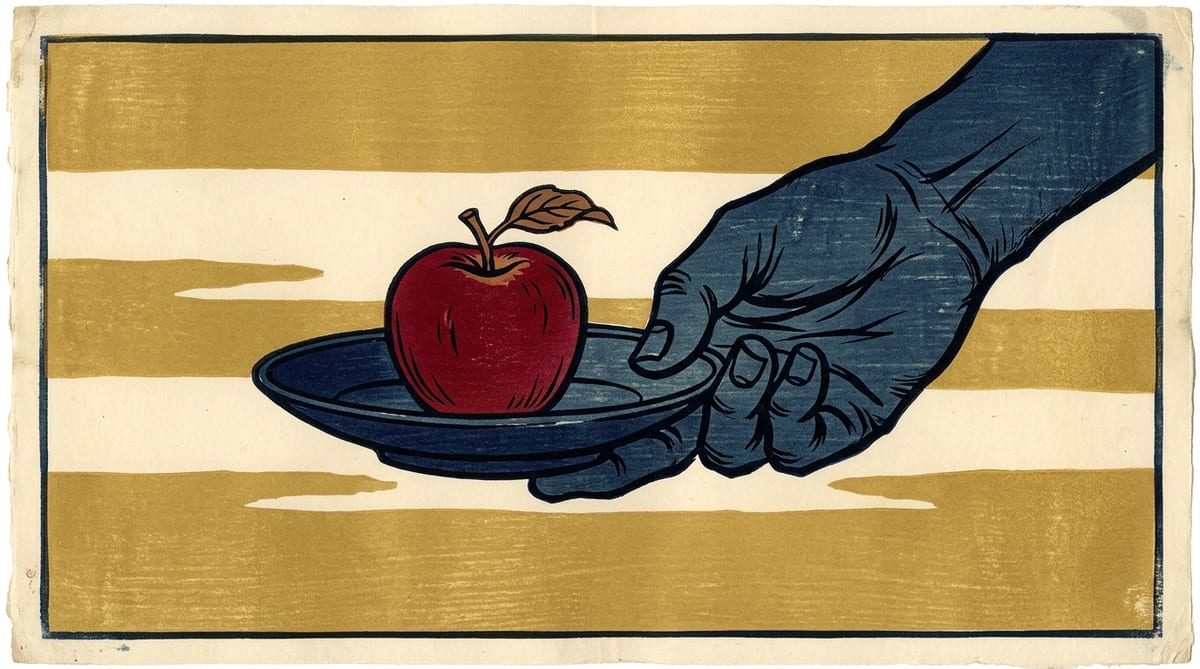
Apple's AI strategy is now a rental agreement. The company that spent a decade arguing its silicon and its privacy architecture were the whole product has handed the hardest part of Siri to Google and pays for the privilege. Two months before that shipped, Apple agreed to pay $250 million to settle claims it advertised a Siri it never built.
The interesting question is not whether Apple fell behind. It obviously did. The interesting question is whether renting the frontier is the disciplined refusal to join a ninety-billion-dollar capital race, or a slow-motion hostage situation, and whether the bet is one worth copying at a smaller scale.
The Payment Direction Just Reversed#
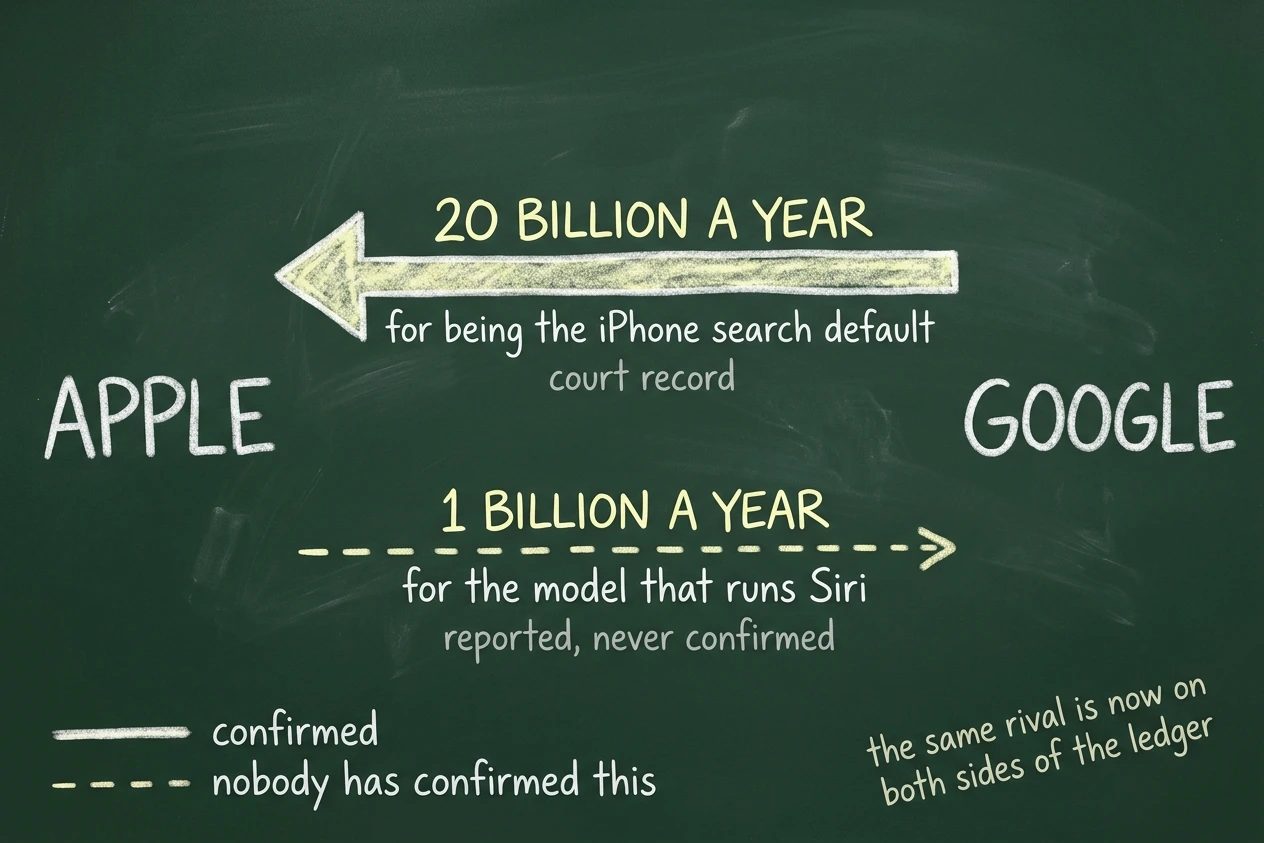
For most of the last decade money between Apple and Google ran one way. Google paid Apple to be the default search engine on iPhone, and the antitrust trial record put the distribution bill above $20 billion a year. Apple did nothing for that money except not change a setting.
Money now runs the other way as well. Apple pays Google roughly $1 billion a year for a custom Gemini model to run the rebuilt Siri, according to Bloomberg's Mark Gurman.
The detail that says the most is the one nobody leads with. Anthropic reportedly quoted $1.5 billion for the same job and lost. Not on capability. On price.
That is a procurement decision, not a technology decision. A company that believed model quality was the durable differentiator does not pick the cheaper supplier for the flagship feature it just paid a quarter of a billion dollars in damages over. Apple picked the cheaper supplier because it had already concluded the model is a part, and parts have prices.
Every Number Traces To One Report#
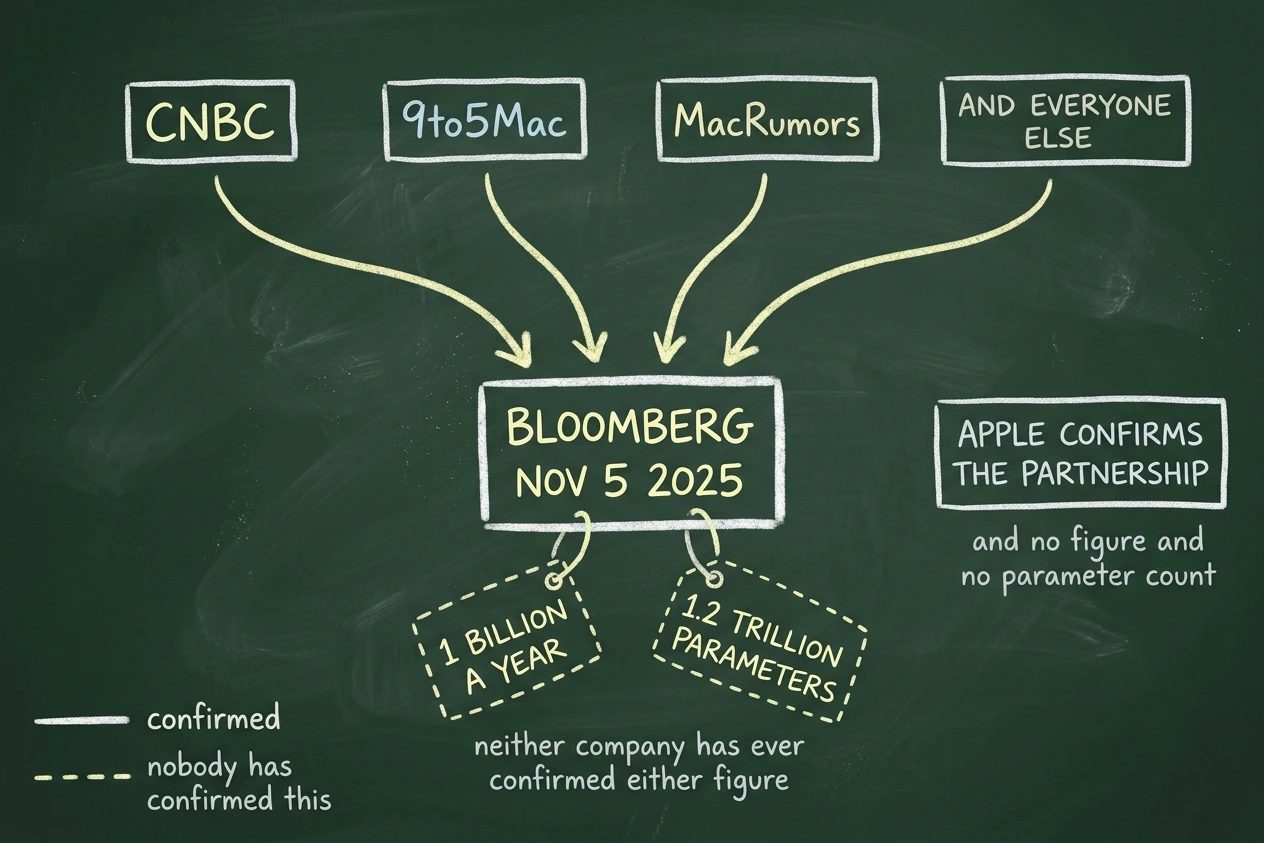
Search this story and the same two figures come back everywhere. One billion dollars a year. A 1.2 trillion parameter model. CNBC has them, 9to5Mac has them, MacRumors has them, and a hundred summaries downstream of those have them.
All of it is one report. Mark Gurman, Bloomberg, November 5 2025. Every outlet carrying those numbers cites Bloomberg, and Gurman posted the same details to X the same day.
Apple has confirmed the partnership. Apple confirmed the Private Cloud Compute expansion at WWDC 2026 in June. Apple has never confirmed a dollar amount or a parameter count, and neither has Google, in any earnings call, SEC filing, WWDC session, or press release.
Gurman's track record on Apple supply-chain reporting is strong, and none of this argues the numbers are wrong. It argues that thirty outlets repeating one source is still one source. The confidence in the room does not match the evidence on the table.
This matters more than sourcing pedantry usually does, because the parameter count is the only public number describing what Apple bought. Strip it out and the deal has no published scale at all. Every analysis of whether Apple got a good price rests on a figure neither party to the contract has acknowledged.
Private Compute On Rented Hardware#
The obvious objection to renting Google's model is that Google now sees every Siri query. Apple's answer is the most technically interesting part of the whole arrangement, and the least covered.
What a request crosses before Google's hardware touches it
The model runs on Google Cloud nodes inside Apple's Private Cloud Compute. Three hardware roots of trust sit underneath it, per Apple's security blog and Google's own account.
- NVIDIA Confidential Computing on the Blackwell GPUs.
- Intel TDX on the CPUs.
- Google's own Titan chip anchoring the boot chain.
Two of those three come from vendors with no stake in the arrangement, which is the actual load-bearing detail. Apple also maintains a cryptographically verifiable append-only ledger of every piece of Google hardware in the fleet, independently of Google, and an iPhone refuses to send a request to any node not on it.
Apple publishes the binaries. Every production PCC image running on Google's machines goes out for researcher inspection, which is a genuinely unusual thing to promise about someone else's datacenter.
Then the caveat that almost nobody printed. Apple shipped this at WWDC 2026 as a beta, saying the deployment would gradually gain its complete set of protections through the summer preview period. MacRumors put it more bluntly, calling it not fully implemented.
So the architecture is real, publicly documented, and auditable in principle. The deployment is incomplete, and no independent security researcher has published an audit of PCC running on Google Cloud yet. Treat the design as a strong claim with the verification still outstanding.
Apple Benchmarks Apple Against Apple#
Apple does publish model numbers, which is more than most vendors managing a capability gap would do. Reading them carefully is where the strategy stops looking like confidence.
The on-device model is around 3 billion parameters. The larger on-device tier, AFM 3 Core Advanced, is a 20 billion parameter sparse model activating 1 to 4 billion at a time. Both are respectable engineering for something running on a phone.
Apple's headline result is that AFM 3 Cloud was preferred on 64.7 percent of prompts against 8.7 percent for the model it replaced. That reads like a capability statement until you check what it was measured against.
It was measured against Apple's own 2025 server model. The 2025 tech report is equally precise about its baseline, claiming Apple's models match or surpass comparably sized open baselines. Comparably sized. Not frontier.
Searching Apple's published research, developer documentation, and WWDC sessions turns up no benchmark against a named frontier model. Not GPT-5, not Gemini Ultra, not Claude. Apple grades itself against last year's Apple and against open models in its own weight class, and both comparisons are honest as long as nobody reads them as a position on the leaderboard.
The consequence is the sharpest thing in this story. The gap Apple is paying about a billion dollars a year to cover is the one quantity nobody has published. Both endpoints are unmeasured, because the frontier comparison does not exist and the rented model's size is unconfirmed.
That is worth sitting with if you evaluate vendors for a living. A published benchmark with a stated baseline is not a claim about the frontier, and reading what a benchmark actually measures is the difference between a number and a decision.
The Commodity Bet, Argued Both Ways#
Apple's wager is that model capability commoditizes and distribution does not. Two billion active devices, a payments relationship with most of them, and silicon nobody else can buy. Rent the brain, own the body.
The case for the bet is mostly arithmetic. Apple spent $12.7 billion on capital expenditure in fiscal 2025 while Alphabet spent $91.4 billion, a figure straight from the 10-K. Alphabet's 2026 plan runs to $205 billion, and Apple has guided nothing remotely comparable.
Renting costs about a billion a year. Competing costs ninety times that and buys a coin flip. Add the inference price collapse, which Epoch AI puts at a median 50x per year across benchmarks, and paying rent on a depreciating input starts to look like the disciplined move rather than the cowardly one.
The case against runs through the same data. Epoch's own measurement of the open-versus-closed gap is 8 index points, comparable to the distance between GPT-5 and GPT-5.5. That is not a rounding error. That is a full model generation, and the lag behind it stretched from roughly three months across 2023 to 2025 out to four months since January 2026.
Commodities are also supposed to be swappable, and this one is welded in. Changing supplier now means re-running the PCC attestation chain against a different vendor's confidential computing stack. The privacy architecture that makes the deal defensible is the same thing that makes leaving expensive, and rules written for open weights do not help when the alternative is another closed vendor with its own hardware assumptions.
Then there is the part almost nobody connects. The same company supplies Apple's AI capability for about a billion a year and its most profitable revenue line at roughly twenty times that.
Judge Mehta's September 2025 remedy did not ban those search payments and did not force a Chrome divestiture. It ordered that default search and AI app contracts be renegotiated annually rather than locked in as long-term exclusives. The DOJ and a group of state attorneys general appealed in early 2026 seeking stronger relief, and that appeal is the live risk.
So Apple's largest high-margin revenue stream is now on an annual clock, held by the same counterparty that supplies the model in its flagship feature. Concentration risk usually means one supplier. This is one company on both sides of the balance sheet.
What Developers Actually Get To Call#
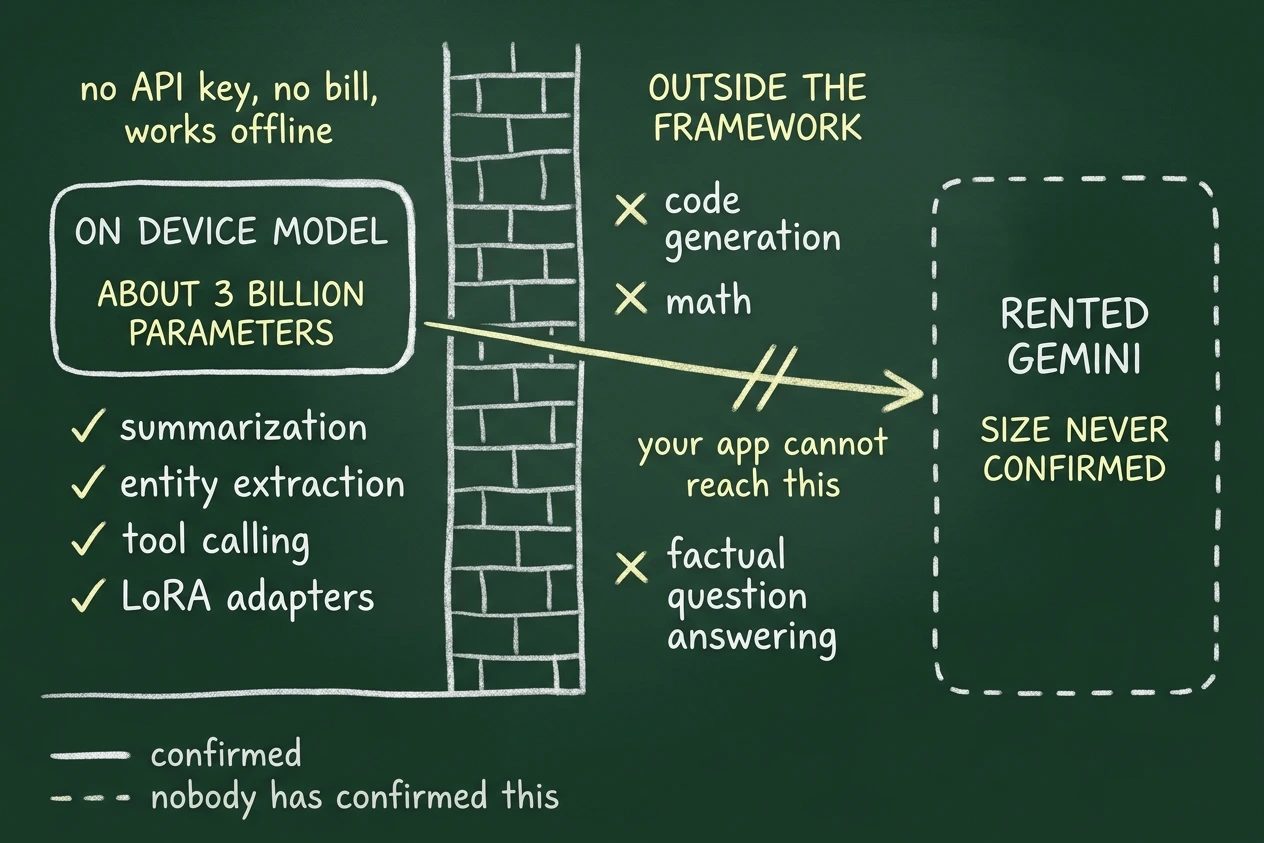
None of this reaches your app in the way you would guess. The Foundation Models framework is where Apple's bet turns into something you can or cannot ship.
What you get is genuinely good for what it is. The roughly 3 billion parameter on-device model, no API key, no inference bill, works on a plane. Summarization, entity extraction, guided generation, tool calling, and custom LoRA adapters are all supported.
- Code generation is explicitly outside the framework's supported use cases.
- So is math.
- So is factual question answering, which rules out most of what a user would think to ask an assistant.
- Third-party apps get no Private Cloud Compute access at all.
That last one is the whole strategy in a single boundary. The rented Gemini is Apple's to call and never yours. Your app gets the small local model, and the frontier capability Apple pays for stays on Apple's side of the wall.
It shows in behavior. iOS developers building AI features are largely routing to third-party APIs rather than Apple's framework, which is a rational response to a tool that excludes code, math, and factual answers.
Apple made a coherent trade for defensible reasons, and the privacy engineering underneath it is real work no competitor has matched. What it bought is a good-enough assistant on unmatched distribution. What it gave up is the ability to answer how far behind it is, because it stopped publishing anything that would measure that.
Copy the trade if your moat is distribution and your model is a feature. Do not copy it if the model is the product, because Apple is about to spend the next few years finding out what it costs to have your most important component priced by the company that also writes your largest cheque.