
Your Team's Real Product Is Now the Prompt Repo
August 3, 2026

Your team's real product is now the prompt repository. Not the chat where someone finally got Claude to stop inventing folder names. The durable surface is the thin, reviewed set of agent instructions, skills, and prompt modules that every coding agent on the team actually loads.
Application code still ships to customers. That part did not change. What changed is the second product. The operating system for agent labor. If that OS lives only in private heads and DMs, every hire and every model bump starts from zero.
The product is not the chat transcript#
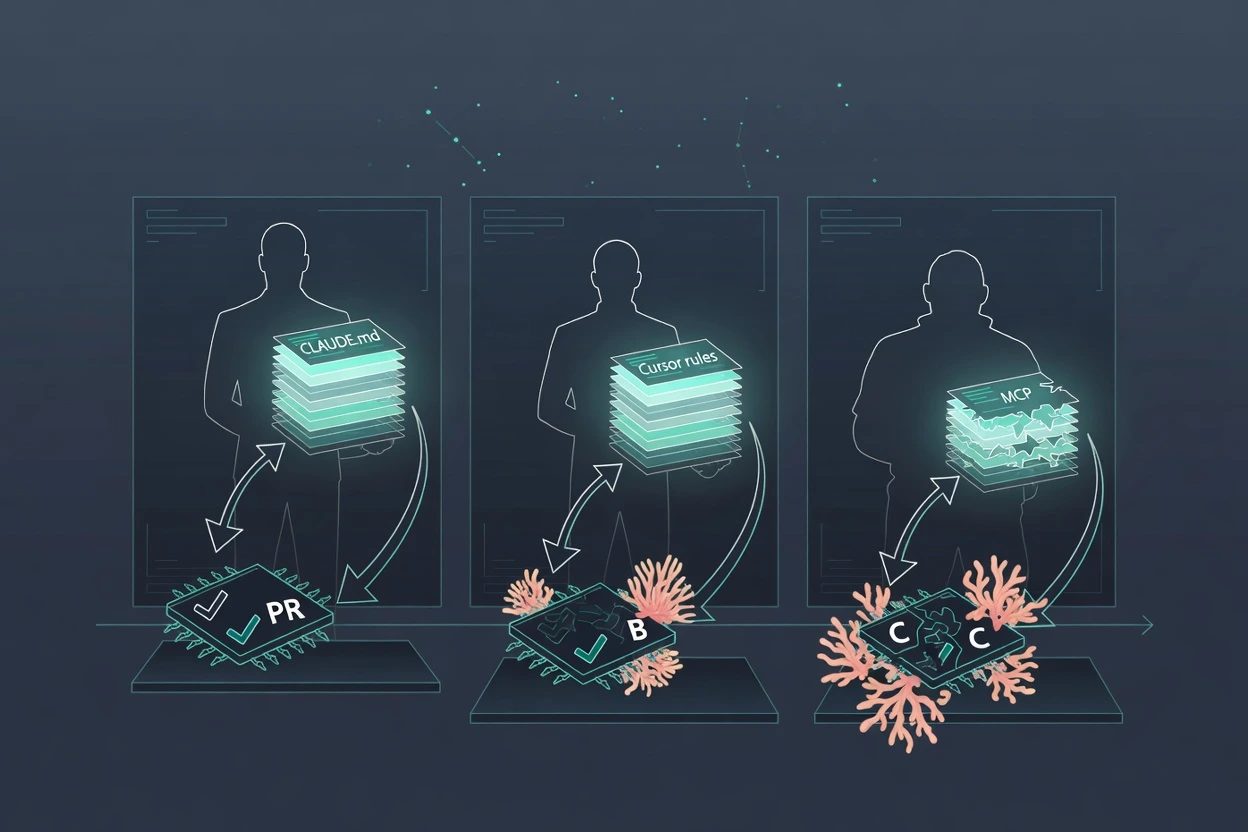
A prompt repo is not a Notion wiki of cute ChatGPT starters. That genre already failed the same way a company-wide Google search library would fail. Generic phrase catalogs help nobody who does not share the same problem.
The real corpus is boring on purpose. AGENTS.md. CLAUDE.md. Cursor project rules. Skills under .claude/skills/. App-side prompt modules next to the product behavior they steer. OpenAI's own docs now put it flatly. Treat prompts as application code, store them in named modules, and review changes in the same pull requests as the behavior they support.
Anthropic's Claude Code library draws the same line with less ceremony. A correction in chat is not shared with the team. A rule committed to the project's CLAUDE.md is. When a prompt works, the next step is not a screenshot. It is a skill someone else can run, plus conventions the next session does not have to relearn. See the Claude Code prompt library.
Chat is a forge. The repo is inventory. Confusing the two is how teams confuse activity with product.
Vendors already ship instruction files as product surface#
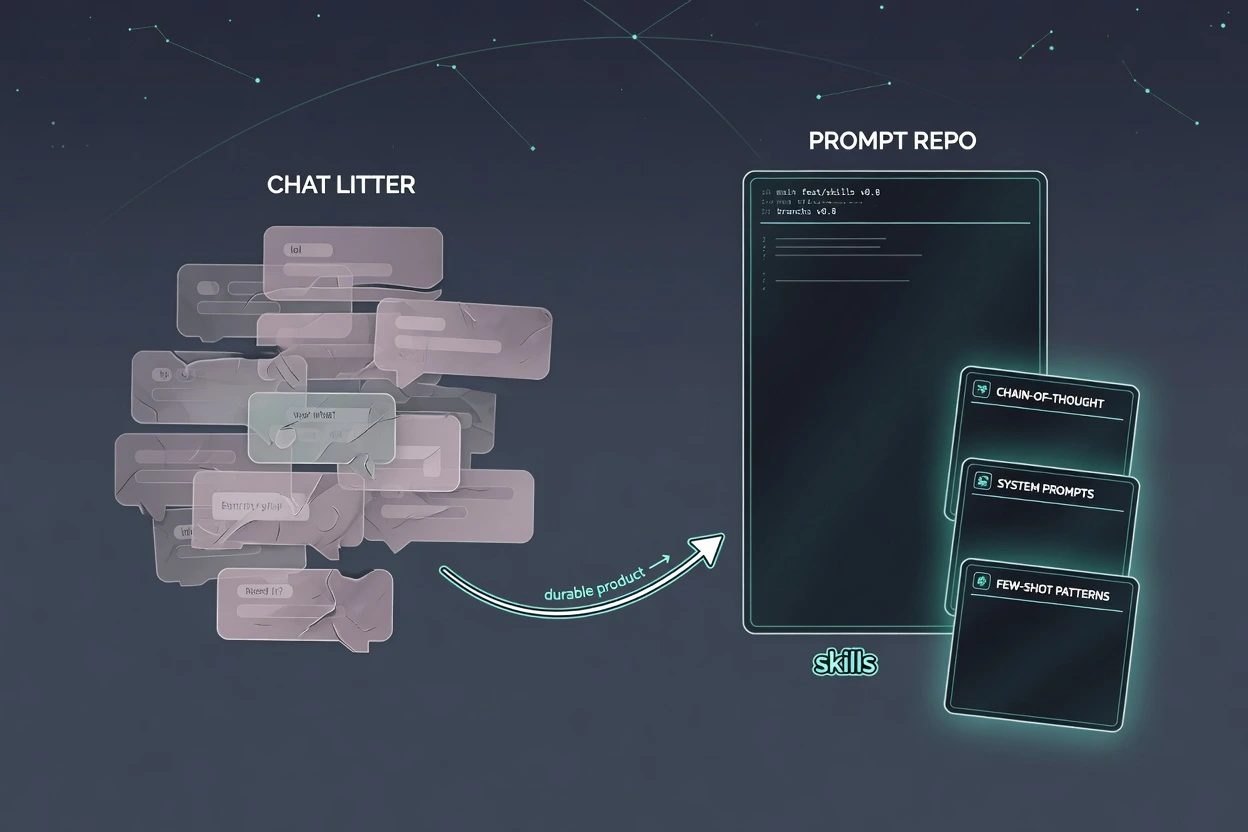
This is not a lifestyle take. The tooling market already productized the surface.
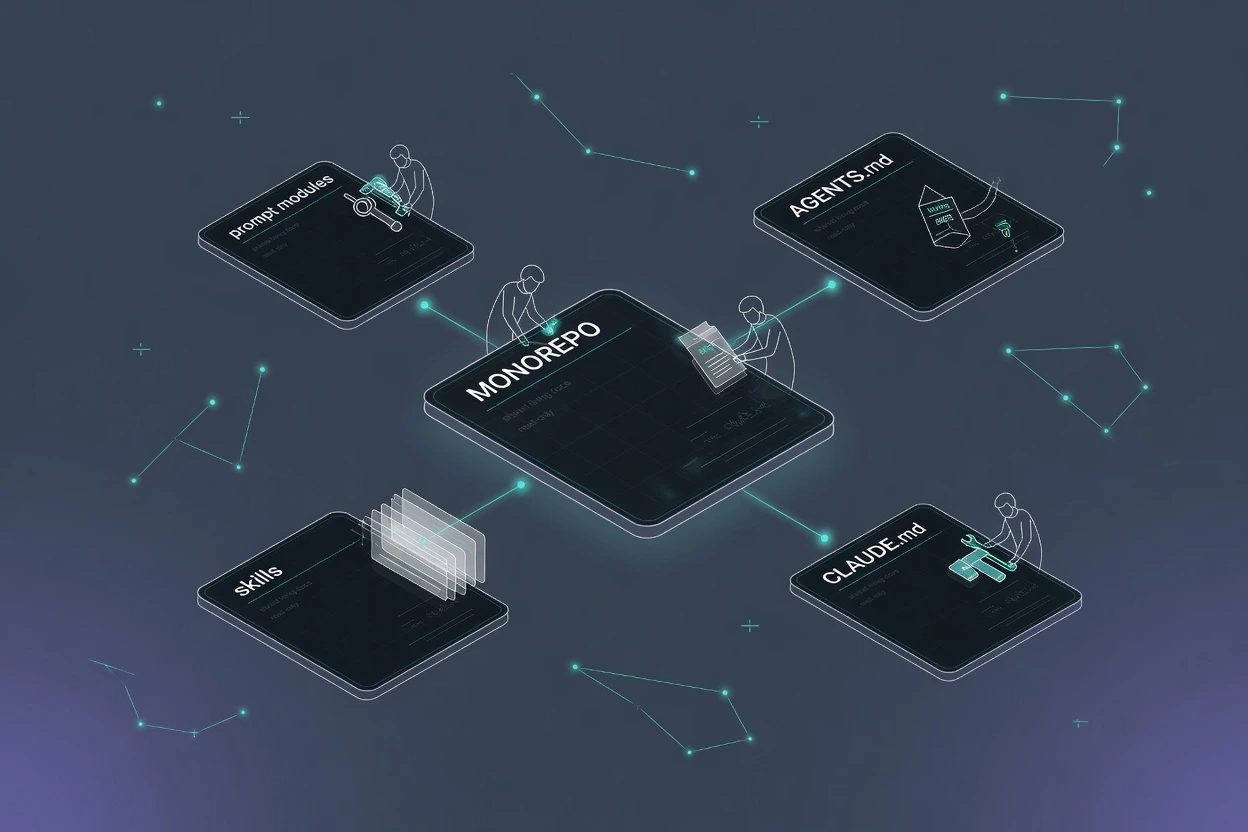
AGENTS.md is framed as a README for agents, stewarded by the Agentic AI Foundation under the Linux Foundation, with support claimed across Codex, Cursor, Copilot coding agent, and a long list of peers. Nested files exist for monorepos. The closest file to the edit wins. Living documentation, not a one-off onboarding paste.
The site points at tens of thousands of GitHub examples and notes large monorepos carrying many nested files (OpenAI's own monorepo is cited at 88). Treat the count as adoption signal, not quality signal. The signal that matters is multi-vendor agreement that agent policy belongs in the tree next to the code.
GitHub's changelog for Copilot coding agent added AGENTS.md custom instructions in August 2025. Cursor's project rules live under .cursor/rules and are meant to be checked into git. Anthropic ships skills as folders of instructions and resources that agents load on demand. The format war is noise. The product fact is the same. Instruction packages are shared software now.
App LLM prompts got the same treatment earlier under PromptOps names. Commits, labels, staging tags. Coding agents lagged, then arrived as files in the monorepo. Same discipline, different path.
Agent config is the new works-on-one-machine#
When the corpus stays private, quality becomes a personal asset. One senior keeps a lethal personal CLAUDE.md. Juniors get the default model with no project memory. Reviews then look like taste arguments. They are config arguments wearing human faces.
A thread on r/ExperiencedDevs put the failure mode in plain language. Different CLAUDE.md content (or none). Different MCP servers. Different Cursor skills and rules. Different permission settings. The punchline was exact. Back to works-on-one-machine, but for AI agent behavior. Read the agent config thread if the pattern sounds familiar.
- Different CLAUDE.md content, or none at all
- Different MCP servers and credentials
- Different Cursor rules and skills
- Different permission defaults for the same agent tool
Instruction sprawl makes the same mess look like model weather. The agent is weird today. Usually it is not. Usually two sessions loaded two different manuals.
Industry survey numbers already show the almost-right tax. Stack Overflow's 2025 writeup reported trust in AI accuracy at 29%, almost-right solutions as the top frustration for 45%, 66% of developers spending more time fixing almost-right AI code, and 75% still asking a person when they do not trust the model.
Those percentages are not a controlled experiment on private versus shared agent config. They are the cost of unreliable agent labor at population scale. Private power-user setups do not fix the tax for the org. They hide it behind the people who already figured out the elicitation.
METR's early-2025 RCT on experienced open-source developers found a 19% slowdown with AI tools while participants still believed they were faster. The authors explicitly left room for better scaffolding and domain-specific elicitation to change outcomes. Shared, versioned project memory is that scaffolding. Not vibes. Not a secret personal mega-prompt.
Evals beat frozen prompt museums#
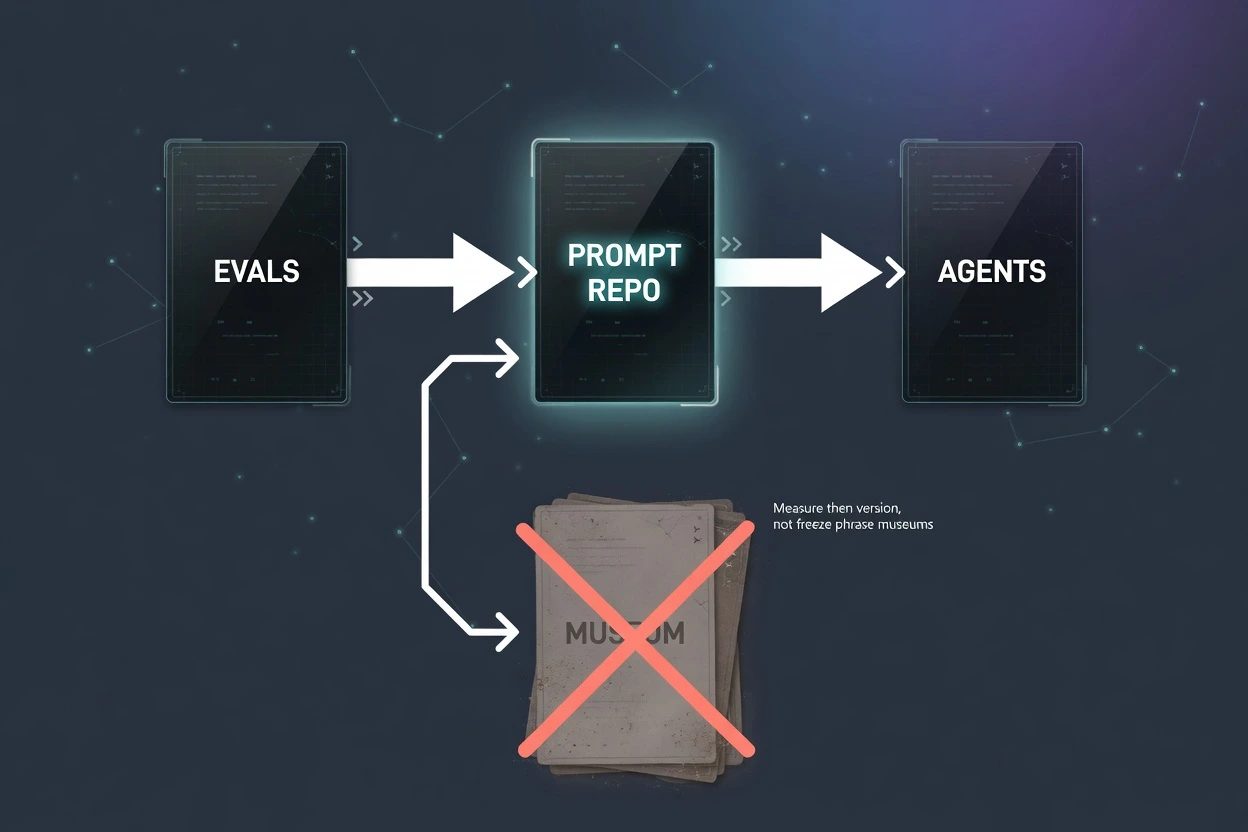
The strongest counter deserves airtime. Evals are the durable AI asset. Essays like dbreunig on knowledge-bank evals put it bluntly. The eval is often more valuable than the model or the prompt text. Measure. Do not collect magic phrases.
IEEE Spectrum's 2024 piece on automatic prompt optimization made the phrase craft case look dead for a reason. Optimizers beat hand-tuned tricks. Prompts overfit models. Swap the base model and last year's few-shots can regress product quality. DSPy-style systems treat optimized text as compiler output, not sacred source.
None of that kills the prompt repo. It kills the museum.
Evals measure whether the agent still ships correct work after a model bump. The prompt repo is the surface under test. Types, tools, thin policy, and skills are the human-authored contracts. The strings that only work on one model release get rewritten under review, not preserved like wine.
Bloat is the other way to fake a product. Dumping every preference into root AGENTS.md wastes tokens and can lower follow-through. That is why fat instruction files hurt coding agents is the sibling warning, not a contradiction. Product does not mean more prose. Product means owned, thin, tested prose.
Govern it like a product surface#
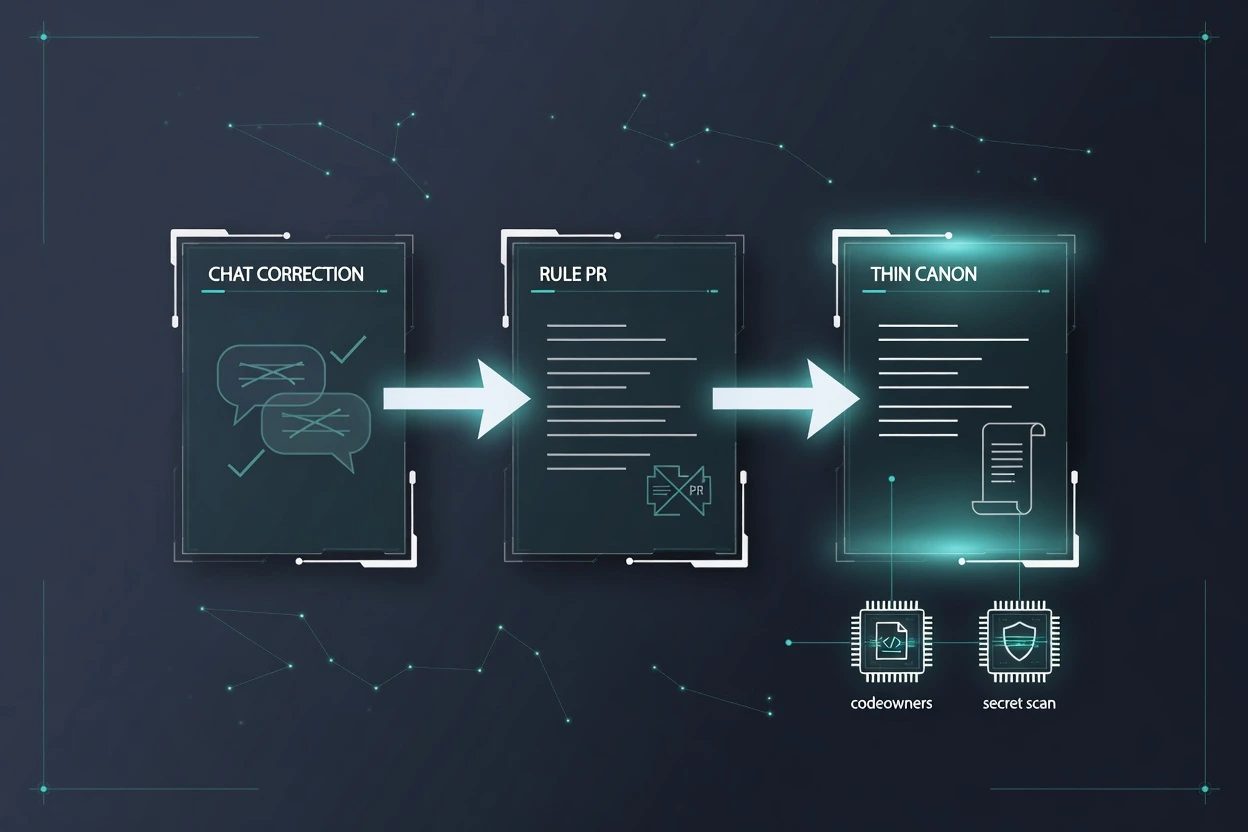
If the prompt repo is product, it gets product discipline. Not a Slack pin. Not a hero engineer's home directory.
- Promotion path. Chat correction becomes a rule PR. A working multi-step ritual becomes a skill. Conventions that agents relearn every Monday land in CLAUDE.md or AGENTS.md. Anthropic documents that ladder in the Claude Code prompt library.
- Ownership. CODEOWNERS on instruction paths. One reviewer who can reject a 400-line dump. Nested files per package when monorepos need different manuals.
- Security. Shared skills without review are not free. Snyk's ToxicSkills audit reported hardcoded secrets in 10.9% of scanned ClawHub skills. Scan instruction packages. Pin versions.
- Rewrite cadence. Model releases age skills and rules. See every model release ages your skills. The repo is not a museum.
Portable core stays in AGENTS.md. Tool-specific overlays only when the tool cannot read the core. Teams that skip the ladder keep paying for rediscovery.
Orchestration still matters when several agents run at once. Partition work, isolate writers, budget review so parallel sessions do not invent cleanup debt. That is the multi-session agent orchestration problem. It sits on top of a shared instruction product. Parallel chaos without a canon just multiplies private manuals.
Prompt repo questions
Is agent config really the new .editorconfig, or is that just forum noise?
The forum framing matches what vendors already document. AGENTS.md is an open multi-agent standard, and Claude Code's own library tells teams to turn chat corrections into committed CLAUDE.md rules. The gap is governance, not the file format.
asked on reddit.com ↗Should prompts live in git or in a prompt management platform?
For coding agents, start in git next to the code they steer. OpenAI now steers production prompts into versioned code modules with PR review. Platforms still help for multi-env app LLM strings, but agent policy that every engineer loads should not hide in a private dashboard.
asked on developers.openai.com ↗If prompt engineering is dead, why invest in a prompt repo?
Magic-phrase craft is dying. Versioned agent policy is not the same thing. Skills, thin project rules, schemas, and tool contracts still load every session. Those need owners, review, and rewrites when models change.
asked on code.claude.com ↗Won't a big shared AGENTS.md just waste context?
Yes, if you dump everything in. Fat instruction files already fail measurement on cost and follow-through. The product discipline is thin rules, nested package files, and skills loaded on demand, not one root novel.
asked on agents.md ↗Holding this position costs vanity. The hero private mega-prompt dies. The team ships a thinner public one. Holding the opposite position costs reproducibility. Every new hire relearns the hard way. Every model bump breaks tribal craft nobody can review.
Change the mind when a team can prove agent labor is reproducible across ICs with no shared instruction surface and stable quality through model upgrades. Until that evidence shows up, the product is the prompt repo. Version it. Review it. Keep it thin.