
What Google's AI Overviews take from developer documentation
July 29, 2026

Google's AI Overviews take less from developer documentation than the panic around them suggests. What they do take moves through the exact same ranking pipe as a review of a blender. The traffic collapse getting pinned on them either started two years before AI Overviews existed, or belongs to a completely different piece of software already generating as many requests on documentation sites as every browser combined.
Technical queries already trigger AI Overviews well above average#
Google confirmed the shift in an April 2025 post, saying Gemini 2.0 for AI Overviews began with 'coding, advanced math and multimodal queries to provide faster and higher quality responses.' BrightEdge's Generative Parser tracked what happened next across a full year, reported by Search Engine Journal. B2B technology queries went from 36% AI Overview coverage to 82%, behind only Healthcare at 88% and Education at 83%.
Semrush's own 10-million-keyword study lines up with that, ranking AI Overview saturation across every category it tracked.
- Science leads at 25.96%, the highest category tracked
- Computers and Electronics follows at 17.92%, third-highest overall
- People and Society sits at 17.29%
- Real Estate, Shopping, and Arts and Entertainment all sit under 3%
None of these studies drill down further than the category level. Nobody has published what happens specifically to a stack trace, an HTTP status code, or a specific API method. That granularity doesn't exist yet, and pretending otherwise would be the more comfortable lie.
AI Overviews use the exact ranking system as everything else#
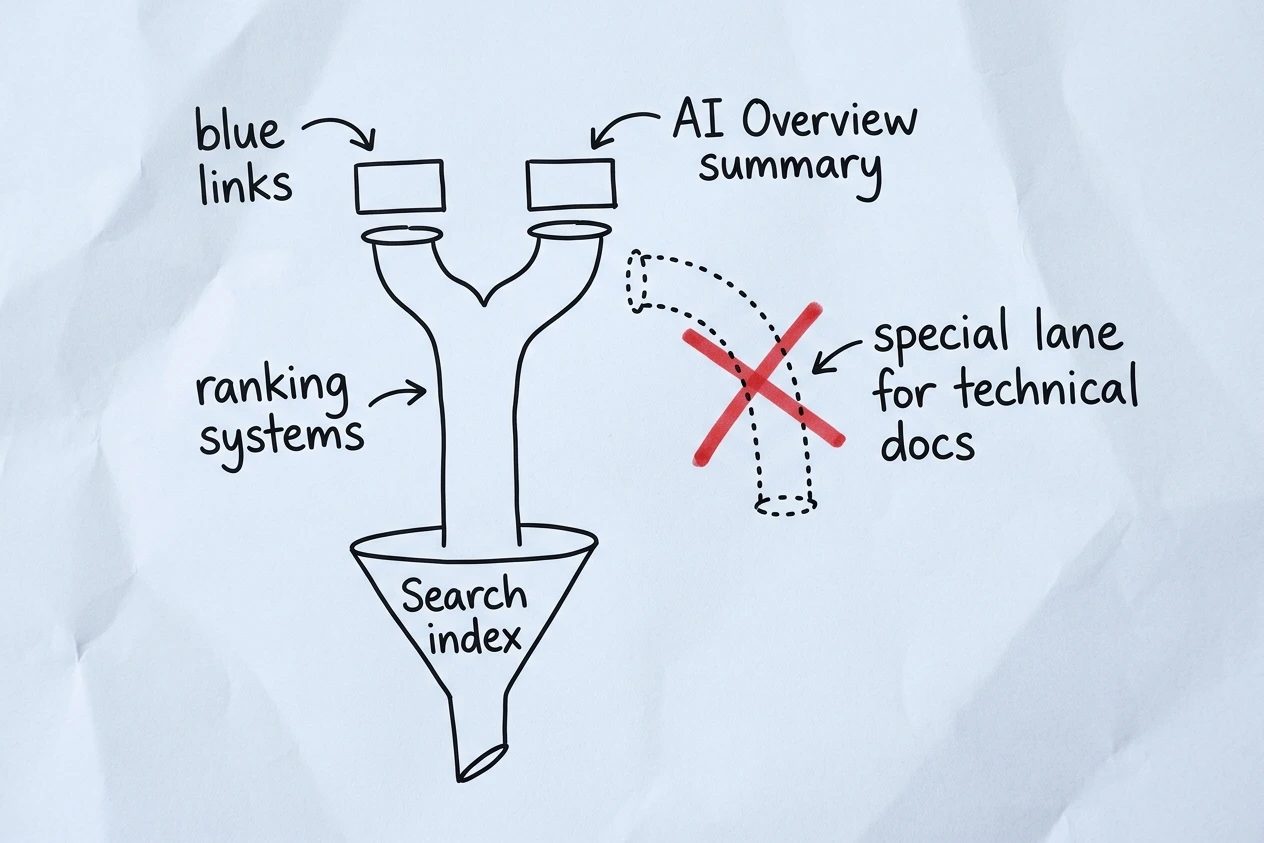
Google's own documentation settles the mechanism question as far as it's willing to. AI Overviews retrieval relies on the standard Search ranking systems to pull pages from the existing Search index, the same index every other query already depends on. Google names one retrieval system there, not a technical-content track, a specialized model, or docs-specific citation logic, and it hasn't published anything describing one either.
The same page states plainly that ordinary SEO practices are what still matter, rooted in the same ranking and quality systems Search has always used. A page that doesn't already rank for a query doesn't get promoted into its AI Overview through some documented side door.
Whatever undocumented tweaks sit inside the model are Google's to know. What's published names one pipe, not two.
Stack Overflow's collapse predates AI Overviews by two years#
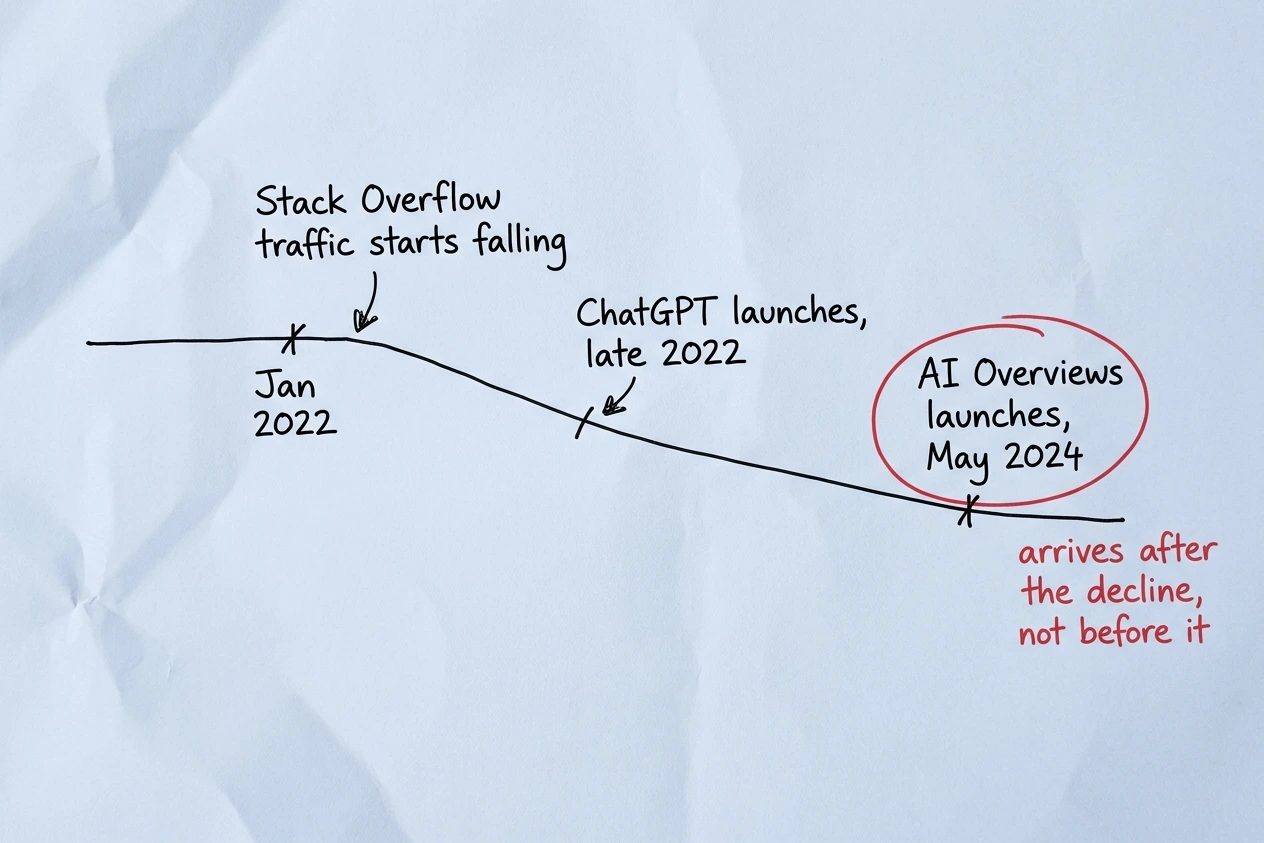
The story is easy to believe. Stack Overflow's monthly question volume fell from over 200,000 at its 2014 peak to under 50,000 by late 2025, a collapse in how many people bothered to ask, and an AI feature summarizing coding answers on the results page sounds like exactly the mechanism that would do that.
Traffic is the separate number that actually dates the cause. Similarweb's own data puts the decline's start in January 2022, averaging 6% down every month and reaching 13.9% down by March 2023. AI Overviews didn't launch until May 2024, fourteen months later. Similarweb names the actual cause directly, pointing at ChatGPT and at GitHub Copilot running 'on top of the same OpenAI large language model as ChatGPT.'
The wrong villain got the headline because it was the villain everyone was already talking about that month, not the one the data actually points to.
An overlooked traffic shift on documentation sites is agentic, not search#
Share of documentation-site traffic by source
Mintlify's own platform telemetry, pulled from roughly 790 million requests across its hosted documentation sites in March 2026, found something Search Console will never show a publisher. AI coding agents already account for 45.3% of all requests, nearly matching browser traffic at 45.8%. Claude Code alone generated 199.4 million of those requests, Cursor another 142.3 million.
Mintlify sells documentation hosting, so the exact percentage deserves a raised eyebrow, and request volume isn't the same measurement as clicks lost somewhere else. What the numbers do establish is that a comparable amount of traffic is arriving through a channel most analytics setups never separately track. An agent fetching a page while it writes your code is a different animal than a human typing a search query, whatever either one turns out to cost a publisher.
Cloudflare's Radar team measured just how lopsided that fetching gets. Anthropic's crawler made roughly 70,900 page requests for every single referral it sent back, for the week of June 19 to 26, 2025. Google doesn't have a comparable number for AI Overviews, because Search doesn't run a separate bot you could even point a ratio at.
Google controls the one number that would settle this, and won't share it#
Nick Fox, Google's SVP of Knowledge and Information, wrote in July 2026 that the company is 'now sending billions of clicks to websites every week through AI features in Search alone.' Google backed that framing with a real product change in May 2026, adding visible attribution to AI Overviews.
- Further Exploration panels linking out beyond the summary itself
- Expert Advice snippets that credit a named source
- Hover-preview cards showing a site's name and page title before a click
- More inline links per AI Overview than the original 2024 version shipped with
None of that changes what Danny Sullivan, Google's own Search Liaison, has already said on the record. Google won't break AI Overview stats out in Search Console, the same way featured snippets never got their own line either.
Ahrefs' Brand Radar study crossed three million U.S. queries spanning every topic, not just technical ones, and still turned up something suggestive. Stack Overflow, GitHub, and official software documentation don't appear anywhere in its top 50 most-cited domains, not near the top, not near the bottom, not at all. Nobody has published the developer-query-only version of that study yet, but a domain absent from the all-topics list starts from a real deficit, not a strong position, whenever a narrower one finally runs. The same opacity playbook shows up in how Anthropic handles its own usage limits, a big number in public with no audit trail behind it.
None of this makes AI Overviews harmless. A feature triggering on 17.92% of Computers and Electronics queries is very likely changing click behavior somewhere in that category, even though nobody outside Google can measure exactly where. What it means is that the number worth being angry about isn't the one making headlines, and pointing an llms.txt file at the AI Overviews problem fixes a mechanism that was never the one taking the traffic.
This position changes the day Google publishes a click number segmented by content type and audited by someone who isn't Google. Until then, what's above is what's actually in the public record, which is already more checking than most 'how to optimize for AI Overviews' posts bother to do.