
SEO Changes Every Week and Almost None of It Matters
July 30, 2026

Google launched 4,781 changes to Search in 2023 and named six ranking updates on its status dashboard that year. Update-news monitoring therefore covers about an eighth of one percent of Google's own recorded launches. The reasonable conclusion is not that search stopped changing. It is that the weekly habit of reading about seo algorithm updates, and adjusting something in response, is aimed at a surface far smaller than it appears.
Google shipped 4,781 changes in 2023 and announced six#
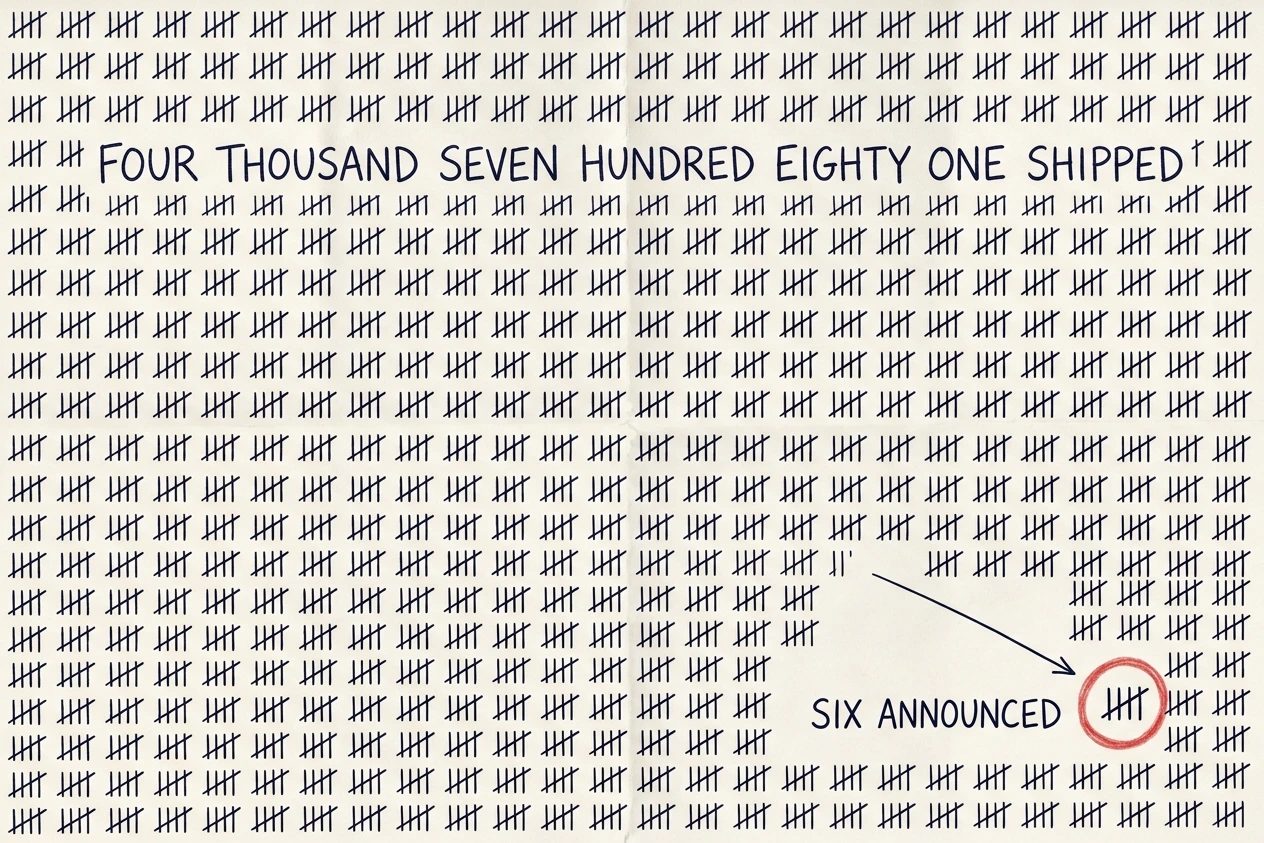
The numbers are not an outside estimate. Google's own testing page publishes them, and they describe a funnel that narrows hard at every stage. 719,326 search quality tests, 124,942 side-by-side experiments, and 16,871 live traffic experiments produced 4,781 launches.
Against that, the Google Search status dashboard lists six named ranking updates for the whole of 2023. The pattern holds since. Seven in 2024, four in 2025, five so far in 2026.
Six against 4,781 is 0.125%, and that ratio deserves an immediate limit before it gets stretched into something it cannot carry. It is an announcement rate, not an actionability rate. An unannounced change can still take a site apart, and nothing here rules that out.
What the ratio does establish is narrower and still worth having. The portion of Google's activity a site owner could even in principle read about is a rounding error against the portion that ships. A reading habit built on update news is monitoring roughly one change in eight hundred.
The announced updates take weeks to land and promise nothing#
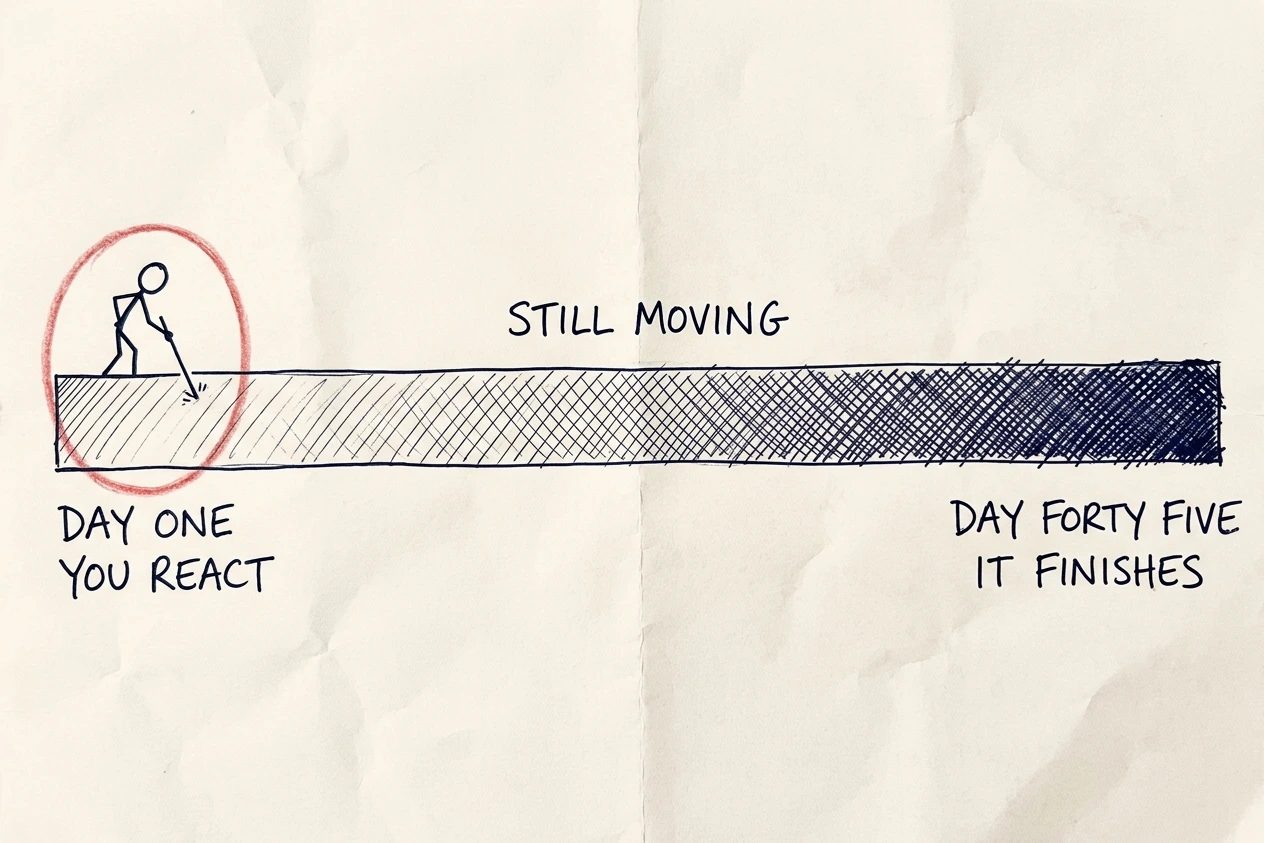
Every confirmed update on the status dashboard carries a published rollout duration, and none of them are instant. The March 2024 core update took 45 days. November 2024 took 23 days and 13 hours.
That headline is weaker than it looks, and the honest version is more interesting. Rollouts have been getting steadily faster. December 2025 ran 18 days, March 2026 ran 12, and the May 2026 core update finished in 11 days and 21 hours, which is roughly a fourfold compression in two years.
Even at the fast end, that is a week and a half. The rankings you are looking at on day three of a rollout are a partial state of a system still moving, and the thing you would be reacting to has not finished happening.
- March 2024 core update, 45 days
- November 2024, 23 days and 13 hours
- December 2025, 18 days
- March 2026, 12 days and 4 hours
- May 2026, the fastest of the five, 11 days and 21 hours
Then there is what the vendor tells you to do about it. Google's core update guidance says to avoid quick-fix changes and instead "focus on making changes that make sense for your users and are sustainable in the long term." On timing, it warns that a recovery "could take several months" before Google's systems confirm a site is producing helpful, reliable, people-first content.
And the sentence almost nobody quotes back. "There's no guarantee that changes you make to your website will result in noticeable impact in search results."
Read those three together. The party with every commercial incentive to keep you optimising is telling you the work is slow, the feedback loop runs in months, and the outcome is not promised. That is not a description of something you respond to on a Tuesday.
The chart that screamed algorithm update was mostly one blog post#
Here is what the panic looks like from inside a real Search Console property, and how quickly it dissolves. Comparing the fortnight of 5 to 18 May 2026 against 19 May to 1 June, impressions on rizz.dev fell from 1,499 to 384. Average position went from 8.4 to 19.5.
The May 2026 core update began on 21 May. Two days after the fall started.
Nothing had shipped on the site. The git history records zero commits between 1 and 26 May, and because this site publishes into Postgres without a rebuild, the publish ledger was checked separately and shows four posts in May, all dated the 27th or later. Twenty-six days of total stillness, and then a cliff.
Every instinct says core update. Every instinct is wrong, and finding out costs one dimension change in Search Console.
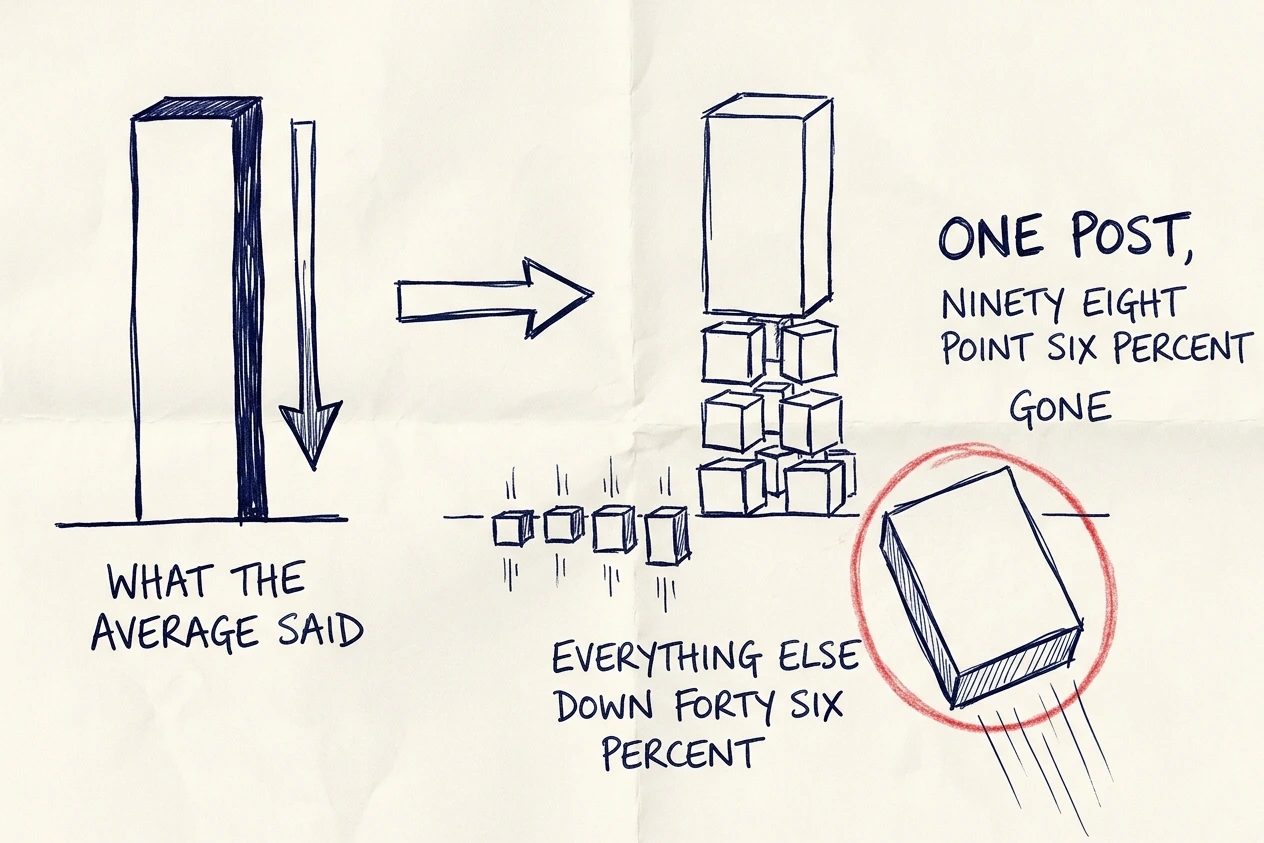
Split by page instead of by date, and the site-wide catastrophe turns out to be one post. A comparison of IntelliJ and VS Code had been carrying 53.4% of everything the property earned, and it fell off a shelf.
- The IntelliJ post, 800 impressions down to 11, a loss of 98.6%
- What the property-level chart showed, a loss of 74.4%
- Every other page combined, 699 down to 373, a loss of 46.6%
- The second-largest page, 41.9% lighter, position band intact
Everything except that one post lost 46.6%, which is real and unpleasant and nothing like a collapse. Ordinary weather for a small site, on a fortnight where a lot of publishers moved.
The property-level average position moving from 8.4 to 19.5 was substantially the mix changing rather than surviving pages sliding. When the page holding half your impressions at position seven leaves, the average of what remains is a different number about a different set of pages.
Which does not prove nothing happened. A 46.6% loss across everything else is a real decline and an algorithmic cause for it stays entirely possible. The point is narrower. The aggregate could not diagnose anything, because it folded one page's near-total collapse together with a broad but much smaller decline and reported the average as though it described the site.
What that one post lost is genuinely odd and the honest answer is that the mechanism is unknown. Its traffic had been spread across a long tail of conversational queries, things like intellij idea vs vs code for java spring boot 2026, none of them individually large. They stopped appearing more or less at once. Several explanations fit and none is established, so none is asserted here.
The limits of this evidence are worth stating plainly, because they are severe. One small site, 118 days, 9,860 impressions and 34 clicks in total. Thirty-four clicks cannot support an argument about anything and are not used for one.
The transferable part is not the number. It is that the first chart anyone looks at, the property-level one Search Console opens on, is the one most likely to manufacture a crisis out of a mix shift.
Sometimes an update does end a site and watching would not have saved it#
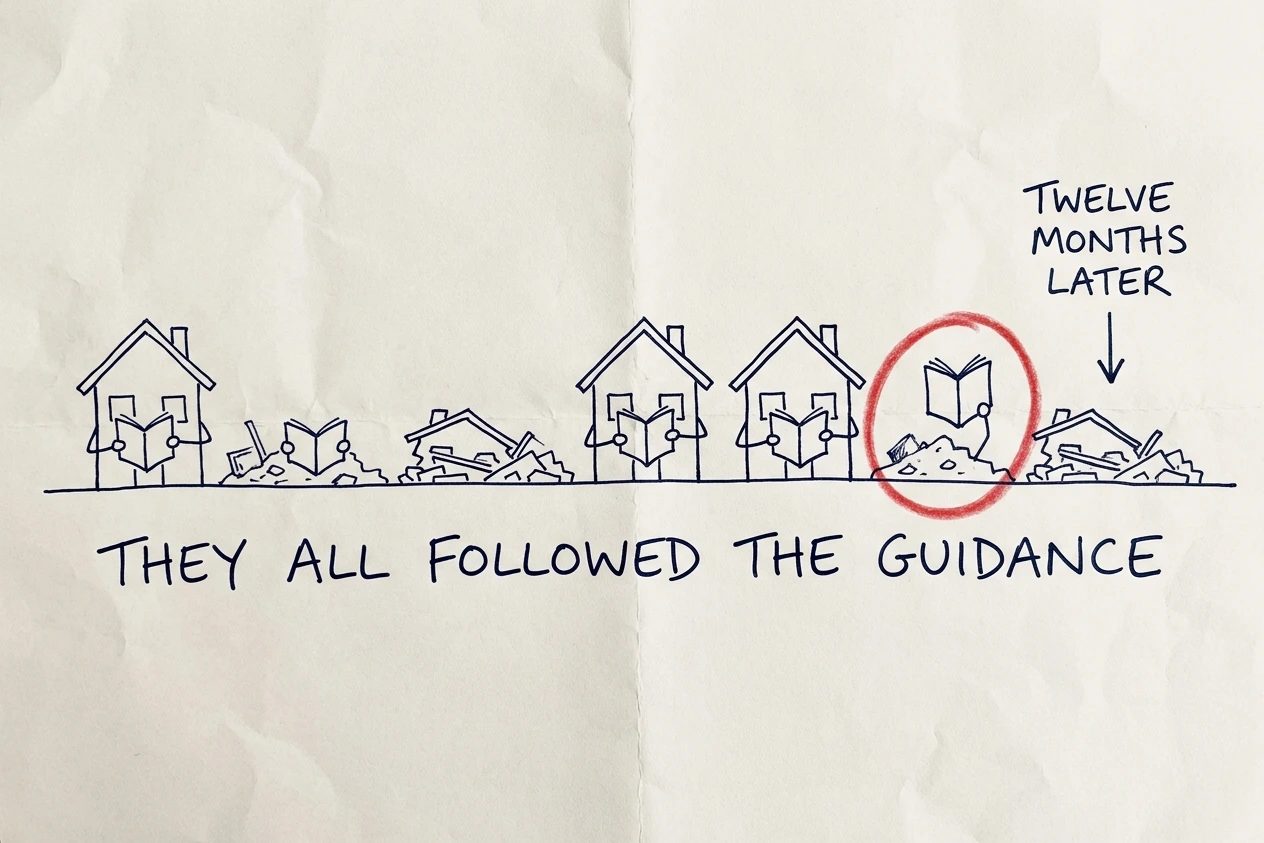
The strongest objection to everything above is that people have watched real sites die, and they are right. The September 2023 helpful content update and the March 2024 core update that followed it did exactly that to a class of independent publishers, with reported losses running from 50% overnight to upwards of 90%.
So the question is not whether updates can be fatal. It is whether watching them closely was ever the defence.
ppc.land's reporting on the aftermath contains the answer, and it is bleak. "Despite these investments and following Google's recommended best practices, many sites report no meaningful recovery after 12 months." The sites that complied did not come back either.
The same shape holds for the genuine structural change of the last two years. Pew Research Center tracked 68,879 searches across 900 US adults in March 2025 and found that visits where an AI summary appeared produced a click on a traditional result 8% of the time, against 15% where no summary appeared.
That is an association rather than a demonstrated cause, and the distinction matters. AI summaries trigger disproportionately on informational queries that were always low-click, so part of the gap is which searches got summarised rather than what the summary did. The figure is also March 2025 data, which is doing present-tense work it was not built for.
Discount it as heavily as you like and it survives as the real thing on the list. It is also the clearest case of a change that no amount of weekly monitoring would have let a small operator respond to, because there was nothing to respond with. The lesson from both cases points the same way. What can wreck you is rare, structural, slow, and mostly not answerable by anything you could have done on the week it arrived. Which is a different argument from technology changing faster than ever, and closer to its opposite.
The churn is real and reacting to it weekly is theater#
Nothing here says search is static or that SEO stopped working. Search changed 4,781 times in a single year, and Pew found AI summaries on about 18% of the searches in its March 2025 panel, with materially different click behaviour alongside them. The churn is the most real thing here.
The claim is about the reaction, not the change. The volume that ships is unreadable, the fraction that gets announced takes eleven to forty-five days to finish landing and carries an explicit no-guarantee, the events that genuinely destroy sites hit people who were watching and complying, and the scariest chart a small site can produce is quite likely to be one page and an arithmetic artifact.
Holding this position has a real cost and it should be named. You will be late to something structural. generative engine optimization went from 110 searches a month in December 2023 to 4,400 now, and someone who tuned out entirely for two years would have missed a fortyfold shift in how people talk about finding things. Ignoring the weekly noise is not the same as ignoring the decade, and the ground AI Overviews are taking from developer documentation is the current version of that.
So the discipline is not indifference. It is refusing to let a rollout that takes six weeks set a seven-day reaction cycle, and checking the page dimension before believing the property chart.
What would overturn all of this is specific and someone could go and measure it. Show that sites which changed something within a week of an announced update recovered materially better than comparable sites that changed nothing, and the weekly habit earns its place immediately. That study does not appear to exist. Until it does, the update calendar is entertainment with a very convincing interface.