How to Actually Find Web Developer Jobs in 2026
April 2, 2026
Web developer jobs in 2026 go to specialists, not generalists. Job postings are down 15% from last year, junior roles get 50+ applicants each, and AI skills separate the candidates who get callbacks from those who don't. Here is what actually works right now.
The Market Split Nobody Warned You About#
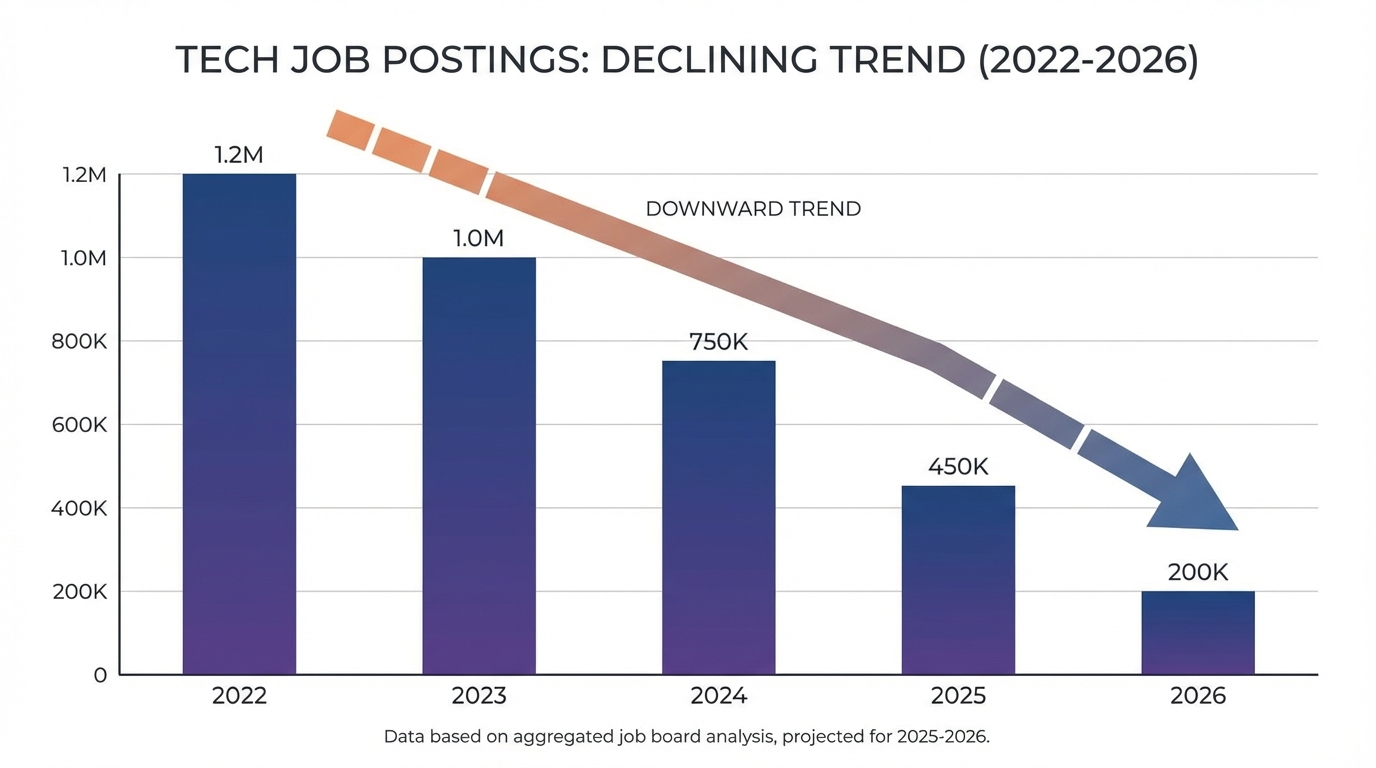
Two years ago, web developer jobs were everywhere. Now, tech unemployment sits at 5.8%, the highest since the dot-com bust. New software engineering postings dropped 15% in early 2026 compared to 2025.
The real story is the split. Companies still cannot find senior engineers who can run complex production systems. But junior and generalist devs face a brutal market with 50+ applicants per opening and a 70% drop in postings from the February 2022 peak.
Web Developer Job Market in 2026
Median re-employment time is 4.7 months, up from 3.2 in 2024. I am not sharing these numbers to discourage you. I am sharing them so you stop comparing yourself to people who got hired in 2021 after two weeks of applying.
AI Skills Are the New Minimum#
72% of tech leaders are reducing entry-level hiring while increasing AI tool investment. Google reports that 25%+ of their new code is AI-generated.
This is not a trend. It is the baseline.
Devs with AI skills earn 15-20% more. That premium exists because most candidates still list "ChatGPT" on their resume and call it a day.
What actually matters in your developer job search:
- Prompt engineering in your IDE (Cursor, Copilot, or Claude Code)
- AI-assisted code review and test generation
- Understanding when AI output is wrong and why
- Building features end-to-end with AI pair programming
Here is how I prove AI skills in interviews. I keep a repo that shows before-and-after diffs of AI-assisted work.
# ai-assisted-portfolio/README.md

## What This Repo Shows
Each folder contains a feature built with AI pair programming.
The commit history shows the human decisions I made along the way.

## Structure
- /feature-auth (JWT auth flow, built with Claude Code)
- /feature-dashboard (React dashboard, Copilot-assisted)
- /feature-api (REST API with AI-generated tests)

Each feature includes a DECISIONS.md explaining what I accepted,
what I rejected, and why.
That DECISIONS.md file is the differentiator. Anyone can generate code. Showing judgment about generated code is the AI developer skills signal hiring managers actually want.
Build a Portfolio That Gets Callbacks#
Passive portfolios do not work anymore. I reviewed dozens of job postings last month and the pattern is clear: deployed demos beat GitHub stars every time.
Your web developer portfolio needs three things:
- Two deployed projects with real URLs (not localhost screenshots)
- A GitHub profile README that explains what you build and why
- At least one project using a production stack (Next.js, database, auth)
Here is a GitHub profile README structure that works:
<!-- Your GitHub Profile README -->
# Hey, I'm [Name]. I build [specific thing].

## What I'm Working On
- [Project Name](link), one-sentence description + live demo link
- [Project Name](link), one-sentence description + live demo link

## Stack
React, Next.js 15, TypeScript, PostgreSQL, Tailwind CSS

## Recent Writing
- [Blog post title](link), shows you think about code, not just write it
Skip the GitHub stats widgets and contribution graphs. Hiring managers spend about 30 seconds on your profile. Give them deployed links and a clear signal of what you specialize in.
Where to Actually Apply (And What to Skip)#
65% of listings are remote-hybrid now. That is good news for your developer job search. But not every platform deserves your time.
Platforms ranked by actual results I have seen in 2026:
- LinkedIn (optimized profile, not just applications). Change your headline to "[Stack] Developer | Building [specific thing]" instead of "Open to Work"
- Wellfound (formerly AngelList) for startup roles. Less competition, faster hiring loops
- Company career pages directly. Skip the aggregator entirely
- Hired and Triplebyte for pre-screened matching
- Skip Indeed and ZipRecruiter for dev roles. The signal-to-noise ratio is terrible
The best CLI tools for developers can help you automate parts of your search. I used a simple script to track applications and follow-ups.
Job Search Timeline by Experience Level

The Freelance Track Most Devs Ignore#
While you search for full-time web developer jobs, freelancing generates income and builds your portfolio simultaneously. Cold outreach of 200-300 emails can produce 5-15 client conversations in a month.
Most devs skip this because passive portfolios and Upwork profiles feel easier. They are easier. They also do not work for a freelance web developer starting from zero.
What does work:
- Pick a niche (restaurants, dentists, real estate agents). Generic "I build websites" emails get deleted
- Send 10 cold emails per day to local businesses with bad websites
- Offer a specific deliverable: "I will rebuild your contact form so it actually works on mobile"
- Price your first three projects low to get testimonials, then raise rates
Here is the cold outreach template I have seen work:
Subject: Quick question about [Business Name]'s website

Hi [Name],

I noticed [specific issue, like a broken mobile menu, slow load time,
missing contact form]. I help [niche] businesses fix exactly this.

Would a 15-minute call this week make sense? I can show you
what I'd change and you can decide if it's worth doing.

[Your name]
[Portfolio link]
The key phrase is "specific issue." Do not say "I can improve your web presence." Open their site, find one broken thing, and name it.
That is the difference between delete and reply.
Senior devs are already using AI to multiply their output. As a freelancer, the same approach lets you deliver faster and charge more.
Your First 30 Days Start Now#
Stop reading advice articles (after this one). Here is the weekly breakdown.
Week 1:
- Deploy two portfolio projects with live URLs
- Write your GitHub profile README
- Update LinkedIn headline and about section
Week 2:
- Apply to 15 targeted positions (not spray-and-pray)
- Send 50 cold emails to local businesses in one niche
- Set up a tracking spreadsheet for every application and email
Week 3:
- Follow up on all week-1 and week-2 outreach
- Add your AI-assisted portfolio repo with DECISIONS.md files
- Start one technical blog post about a problem you solved
Week 4:
- Review what got responses and double down on that channel
- Apply to 15 more positions
- Send 50 more cold emails (refine your template based on week-2 results)
The developer job search in 2026 is a 4-7 month project. Not a weekend task. The people who land web developer jobs are the ones who treat it like a job itself: structured hours, tracked metrics, weekly adjustments.
Your first action today: deploy one project. Not tomorrow. Today.